Habibi Meaning: Habibi (حبيبي) is an Arabic term of endearment meaning “my beloved” or “my dear.” Rooted in the classical Arabic word hubb (love), it’s one of the most emotionally rich words in any language — warm, versatile, and deeply human.
One word. A thousand feelings. That’s Habibi’s superpower — it shifts from romantic whisper to brotherly fist-bump without missing a beat.
From Cairo’s bustling streets to TikTok’s viral sounds, habibi has crossed every border imaginable. Understanding its true meaning transforms how you connect, communicate, and appreciate one of the world’s most beautifully expressive languages.
What Does Habibi Actually Mean? (Start Here)
The Literal Arabic Translation
Habibi (حبيبي) breaks down into two parts: habib (حبيب), meaning “beloved” or “dear one,” and the suffix -i (ي), which means “my.” So the habibi literal meaning is, quite simply, “my beloved” or “my dear.”
But here’s the thing — that translation doesn’t do the word justice. “My beloved” sounds formal and almost Victorian in English. In Arabic, habibi is casual, warm, and deeply human. It rolls off the tongue the way “buddy” or “babe” does in English, except with more emotional weight behind it.
What It Really Communicates (Beyond the Dictionary)
The habibi cultural meaning goes far beyond romance. It’s an expression of closeness. When an Arab man says it to his friend, he’s signaling trust and brotherhood. When a mother says it to her child, it’s pure tenderness. The When a shopkeeper says it to a customer, it’s a respectful warmth.
Think of it like this: habibi is the Arabic equivalent of putting your hand on someone’s shoulder. It says, “You matter to me.”
Why One Word Can Mean 10 Different Things — Context Is Everything
The habibi meaning in different contexts shifts dramatically based on:
- Tone of voice — soft and slow means love; sharp and quick means frustration
- Relationship — romantic partner vs. stranger vs. old friend
- Region — an Egyptian habibi sounds and feels different from a Lebanese one
- Platform — habibi in a WhatsApp voice note hits differently than habibi in a TikTok caption
Quick-Reference Meaning Table
| Context | Who Says It | What It Really Signals |
|---|---|---|
| Romantic partner | Any gender | Deep affection, intimacy |
| Close male friends | Men to men | Brotherhood, loyalty |
| Parent to child | Any parent | Unconditional tenderness |
| Host to guest | Anyone | Warmth, respectful welcome |
| Sarcasm / frustration | Anyone | “Come on, seriously?” |
| Online / social media | Anyone globally | Casual coolness, cultural appreciation |
The Real Origin of Habibi — Linguistic & Cultural Roots
Where the Word Comes From (Classical Arabic Breakdown)
The habibi root word traces back to the Arabic trilateral root ḥ-b-b (ح ب ب) — the foundational root for love in the Arabic language. From this root, Arabic builds an entire family of words:
- Hubb (حب) — love
- Habib (حبيب) — beloved, dear one
- Mahaba (محبة) — affection, fondness
- Habibi (حبيبي) — my beloved (masculine)
- Habibti (حبيبتي) — my beloved (feminine)
The habibi spelling in Arabic is حبيبي — five letters that linguists trace back to some of the oldest forms of Semitic language. This isn’t new vocabulary. It’s ancient.
How Old Is This Word? A Brief Historical Trail
Habibi, meaning in Arabic, predates Islam. The word appears in pre-Islamic Arabic poetry — specifically in the Diwan tradition, the classical Arab poetic canon that dates back to the 6th century CE. Poets like Imru’ al-Qais used derivatives of ḥ-b-b to describe longing and devotion in ways that still resonate today.
After the rise of Islam, the word deepened further. The term habibi, in Islam, carries spiritual weight too — the Prophet Muhammad is famously called Habibi Allah (حبيب الله), meaning “the beloved of God.” That’s how sacred this root is.
Regional Variations Across the Arab World
Here’s something most articles miss: Habibi doesn’t sound or feel the same in every Arab country.
| Region | Pronunciation Variation | Connotation Nuance |
|---|---|---|
| Egypt | Ha-BEE-bi (elongated) | Extremely common, almost punctuation |
| Lebanon | Ha-BEE-bi (clipped, stylish) | Warm but also fashionable |
| Gulf (Saudi, UAE) | Ha-BEE-bi (formal weight) | More reserved, used with intent |
| Morocco | Ḥbib (shortened) | Casual, rapid in speech |
| Iraq | Ḥabibi (deeper resonance) | Carries strong emotional sincerity |
Egyptians, famously, use it almost as a verbal comma. You’ll hear it mid-sentence, at the end of requests, and sometimes just as a standalone greeting. Gulf Arabs tend to use it with more deliberate warmth.
How Habibi Escaped the Arab World — The Global Spread Timeline
The word didn’t go global overnight. Here’s the actual timeline:
- 1970s–90s: Lebanese and Egyptian diaspora communities carry the word into Europe, the Americas, and Australia
- 1990s–2000s: Arabic pop music — Nancy Ajram, Amr Diab, Fairuz — beams habibi into millions of non-Arab homes
- 2000s: Bollywood films and Turkish dramas borrow Arabic expressions, including habibi, spreading them across South Asia and the Middle East
- 2010s: YouTube and early social media make Arabic meme culture globally accessible
- 2020–2026: TikTok supercharges the word into a full-blown global cultural token — the habibi TikTok trend makes it recognizable from Lagos to Los Angeles
How to Use Habibi Naturally: Context-by-Context Breakdown
In Romantic Relationships
Between partners, habibi, meaning in love, is everything you’d expect — and more. It’s not just a pet name. It’s a gesture of emotional proximity. Arab couples use it constantly, the way English speakers might say “babe” or “honey.”
Examples of habibi in sentences (romantic):
- “Habibi, I missed you today.”
- “Ya habibi, you always know what to say.”
- “Come here, habibi.”
Ya habibi meaning: The ya (يا) is a vocative particle — it’s Arabic for calling someone’s attention, like “O” in old English poetry. Ya habibi adds warmth and directness. It’s softer and more tender than habibi alone.
Between Friends — The “Bro” Use Case
This is where non-Arabs get confused most often. Arab men call each other habibi constantly. It doesn’t imply romance. It implies brotherhood. Think of it as the Arabic equivalent of “bro” — except with genuine emotional depth attached.
“Why do Arabs say habibi so much?” — Because closeness is valued loudly in Arab culture. Affection between friends isn’t hidden; it’s celebrated.
Habibi meaning for friends = “I’ve got you. You’re my person. We’re solid.”
In Family Settings
A parent calling a child habibi is one of the most tender sounds in the Arabic language. Grandmothers say it to grandchildren with a softness that no English translation captures. Siblings use it as casual shorthand for “I love you without saying I love you.”
Habibi meaning for family:
- Parent → child: unconditional love and protection
- Sibling → sibling: warmth without sentimentality
- Grandparent → grandchild: deep, generational tenderness
In Hospitality & Polite Interactions
Walk into a shop in Cairo, Beirut, or Dubai. The shopkeeper will call you habibi within thirty seconds — and mean nothing romantic by it. This is habibi as a social lubricant. It signals: “You’re welcome here. I respect you.”
Is habibi formal or informal? In hospitality contexts, it’s a polite, informal, warm but not intimate. The Western equivalent would be “sir,” said with a genuine smile instead of stiff professionalism.
Sarcastic, Humorous & Playful Uses
Here’s the edge most people don’t see. Habibi can mean the opposite of affection when delivered with the right tone.
Picture an Arab dad watching his teenager do something ridiculous. He sighs and says, “Habibi… what are you doing?” That’s not love. That’s exasperated fondness — the emotional equivalent of a slow headshake and a grin.
Arab comedy leans into this hard. The word becomes funnier the more it contrasts with the situation. The habibi meme meaning online often exploits exactly this gap — the word sounds warm while the situation is chaotic.
Using It as a Non-Arab — What’s Fine, What’s Cringe
Can non-Arabs say habibi? Yes — with awareness.
Using habibi because you genuinely love Arabic culture, and it’s become part of your vocabulary? That’s authentic. Using it performatively to seem exotic or funny? That’s where it gets uncomfortable.
Most Arab people actually appreciate non-Arabs using habibi warmly and sincerely. What they find cringeworthy is the caricature — the exaggerated accent, the joke that reduces the word to a punchline. Use it like you mean it, and you’re fine.
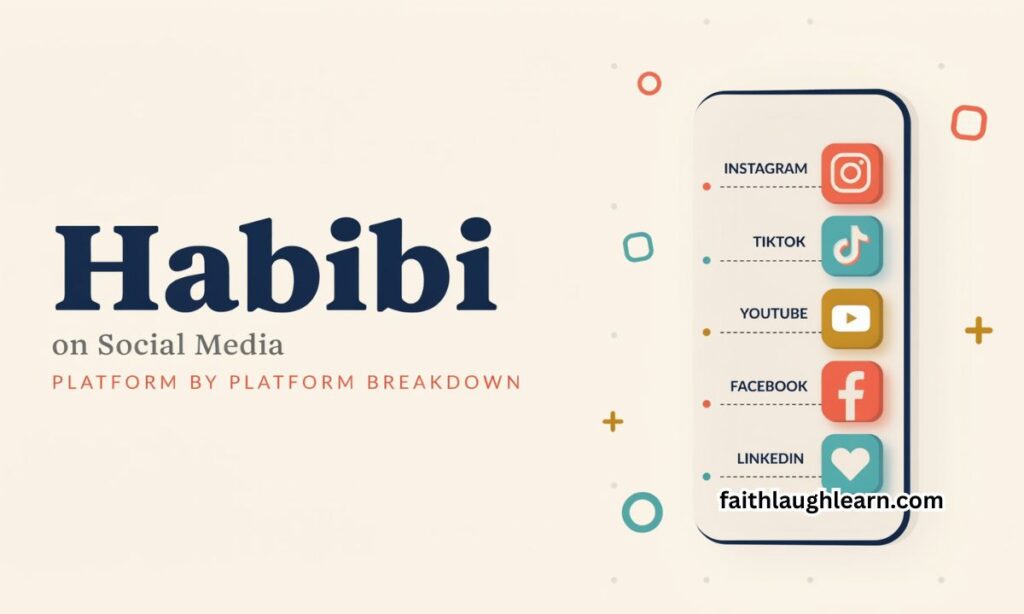
Habibi on Social Media — Platform-by-Platform Breakdown
WhatsApp — The Everyday Intimacy App
Habibi, meaning in WhatsApp conversations, is almost entirely about closeness. In Arab families and friend groups, it peppers voice notes and texts the way punctuation does. It’s not weighted — it’s habitual warmth.
In texting, habibi ” means in chat signals:
- Affection between close friends
- A soft opener before a request (“Habibi, can you do me a favor?”)
- Genuine love in relationship messages
Instagram — Captions, Comments & Couple Culture
Arab and South Asian creators helped make Habibi an Instagram staple. You’ll see it in:
- Travel captions: “Dubai with my habibi 🌙”
- Food posts from Arabic cuisine accounts
- A couple of photos where it replaces “babe” or “love.”
Habibi, meaning Instagram = coolness + cultural warmth + aesthetic intimacy.
TikTok — Memes, Sounds & Viral Moments
What does habibi mean on TikTok? Several things, depending on which corner you’re in.
- Arabic creators use it sincerely in daily vlogs and family content
- Non-Arab creators use it in reaction videos and comedic skits
- The iconic “come here, habibi” audio clips spawned thousands of videos
The habibi TikTok trend peaked between 2021 and 2024 and continues to hold cultural currency in 2026. It’s now embedded in Gen Z’s casual vocabulary — used both sincerely and ironically, depending on the creator.
Snapchat & DMs — Flirty Shorthand or Friendly Default?
Habibi, meaning Snapchat, depends almost entirely on who’s sending it. From a close friend? Brotherhood/sisterhood. From someone you just matched with? Probably flirtatious. From a family member? Pure warmth.
What does habibi mean in texting when a stranger uses it? Proceed with context. Some people use it as a cultural default. Others use it as a deliberate softener before something flirtatious.
Dating Apps — Tinder, Hinge, Bumble
Is using habibi in a dating opener charming? It can be — if it feels natural to who you are. Arab men often use it instinctively because it’s embedded in their communication style. Non-Arabs using it as an opener can come across as either endearing or try-hard, depending on execution.
Habibi, meaning in relationships on apps, signals warmth and cultural identity. It often tells you something about where the person grew up or how they were raised.
Habibi vs. Similar Arabic Terms — Know the Difference
Habibi vs. Habibti
This is the most common confusion. The difference between habibi and habibti is purely grammatical gender:
| Word | Arabic | Gender | Used For |
|---|---|---|---|
| Habibi | حبيبي | Masculine | Said to males |
| Habibti | حبيبتي | Feminine | Said to females |
Can you call a girl habibi? Technically, it’s grammatically incorrect — habibti is the right form for women. However, in casual online usage, habibi is increasingly used as gender-neutral. Among younger generations, especially, the distinction is loosening.
Habibi vs. Hayati
Hayati (حياتي) means “my life.” It’s significantly more intense than habibi — reserved almost exclusively for deep romantic love. You wouldn’t call a friend Hayati. It’s the Arabic equivalent of saying “you are my everything.”
- Habibi = my dear / my beloved (warm, versatile)
- Hayati = my life (deeply romantic, serious)
Habibi vs. Omri
Omri (عمري) means “my life” or “my age” — similar to hayati in weight. It’s less commonly known outside the Arab world but carries enormous emotional sincerity. Mostly used in romantic or deeply familial contexts.
Habibi vs. Albi
Albi (قلبي) means “my heart.” It’s softer and often more parental — grandmothers favor it. Less romantic than hayati, more tender than habibi.
Arabic Love Nicknames — Full Comparison Table
| Arabic Word | Transliteration | Meaning | Best Used For |
|---|---|---|---|
| حبيبي | Habibi | My beloved | Everyone — versatile |
| حبيبتي | Habibti | My beloved (f) | Women specifically |
| حياتي | Hayati | My life | Romantic partners |
| قلبي | Albi | My heart | Family, deep affection |
| عمري | Omri | My life/soul | Romantic, poetic |
| روحي | Rohi | My soul | Deep love, poetry |
| عزيزي | Azeezi | My dear (m) | Formal affection |
Habibi vs. English Equivalents
No English word is a perfect translation — and that’s the point.
| English Word | What It Misses |
|---|---|
| Darling | Too formal, almost old-fashioned |
| Babe | Too casual, lacks cultural depth |
| Bro | Too flat, no emotional warmth |
| Buddy | Too distant, almost corporate |
| My love | Too heavy for casual use |
Habibi sits in a gap that English doesn’t have a word for — simultaneously casual and heartfelt.
How to Respond When Someone Calls You Habibi
Natural Arabic Replies
How to reply to Habibi depends on your comfort level and the relationship. Here are the most natural responses:
| Situation | Response | Meaning |
|---|---|---|
| Close friend | Ya habibi! | Right back at you, warmly |
| Romantic | Enta/enti habibi/habibti | You are my beloved too |
| Casual | Habibi! (mirrored) | Mutual warmth, acknowledged |
| Formal/polite | Shukran, habibi | Thank you, dear |
Habibi Pronunciation Guide
Habibi pronunciation: hah-BEE-bee
- Ha — like “ha” in “harp” (slight throat emphasis)
- Bi — like “bee” (stressed, elongated)
- Bi — like “bee” again (softer ending)
The emphasis falls on the second syllable. Elongating the middle bee is what makes it sound natural rather than robotic.
When You’re Uncomfortable with It
If a stranger uses habibi in a way that feels forward, you don’t have to mirror it. A simple, warm English reply keeps things polite without engaging in intimacy. Arab culture values respect enormously — a genuine smile and a neutral response won’t offend.
Common Misconceptions About Habibi — Set the Record Straight
“It’s Always Romantic” — Wrong
Is Habibi romantic or friendly? Both — and neither exclusively. The majority of habibi usage globally is non-romantic. Friends, family, shopkeepers, hosts — they all use it. Assuming romance is a Western projection onto an Arabic word that’s far more versatile.
“Only Women Say It to Men” — Wrong
There’s no gender rule here. Men say it to men constantly. Women say it to women. Parents say it to children of any gender. Habibi is gloriously gender-fluid in practice, even if habibti is the technically feminine form.
“It’s Just Slang” — Wrong
Is habibi slang or formal? Neither, exactly. It’s standard conversational Arabic — not formal, but absolutely not slang. It appears in classical poetry, religious texts, and modern literature. Calling it slang undersells it significantly.
“It Means the Same Everywhere in the Arab World” — Wrong
As the regional table above shows, the meaning in different cultures shifts. An Egyptian using it 40 times in a conversation is normal. A Gulf Arab using it three times in the same conversation is expressing genuine warmth each time. Frequency doesn’t equal insincerity — but it does vary by region.
“Non-Arabs Using It Is Always Appropriation” — More Nuanced Than That
Language travels. Words cross borders. The global adoption of Habibi is largely seen positively by Arab communities — it’s a sign that their culture resonates worldwide. Misunderstanding the meaning or using it mockingly is the issue. Genuine warmth never is.
“Saying It to a Stranger Is Inappropriate” — Context-Dependent
In a hospitality context, calling a stranger habibi is completely normal and warm. In a Western professional context, it might feel too familiar. Read the room — that’s the real rule.
Habibi in Pop Culture — Music, Film & Media
Iconic Songs That Made the World Famous Globally
Habibi in Arabic songs is practically its own genre. Some of the most influential:
- Amr Diab — “Habibi Ya Nour El Ain” (1996): arguably the song that put habibi on the global map, with over 200 million streams across platforms
- Nancy Ajram — Built an entire career on music that uses habibi as emotional shorthand for pop romance
- Fairuz — The legendary Lebanese singer whose habibi-laced ballads are considered national treasures across the Arab world
- DJ Snake ft. various Arab artists — Western-Arab fusion tracks that brought habibi into EDM culture
Movies & TV Shows Where It Appears
Hollywood and streaming platforms use habibi as a cultural marker — sometimes well, sometimes lazily. The word appears in shows set in the Middle East as a way to signal authenticity. When it’s used thoughtlessly, Arab viewers notice immediately.
Memes & Internet Culture That Immortalized It
The habibi viral meaning online is equal parts sincere and comedic. The “come here, habibi” meme format — where someone beckons another character toward something absurd or dangerous — became a staple format across Reddit, Twitter/X, and TikTok between 2020 and 2024. It works because habibi sounds warm while the situation is chaotic. That contrast is the joke.
Popularity Trends — Is Habibi Growing or Fading?
Google Trends Data — Search Volume 2015–2026
According to Google Trends data, global searches for habibi meaning have followed a clear upward trajectory:
- 2015–2018: Steady low-level interest, mostly from diaspora communities
- 2019–2020: Gradual climb as Arabic content grows on YouTube
- 2021–2022: Sharp spike driven by TikTok virality
- 2023–2024: Peak search volume globally
- 2025–2026: Stabilized at a high baseline — the word is now embedded in global internet vocabulary
Where in the World People Search It Most
Top countries searching for what does habibi mean and related queries:
- United States
- United Kingdom
- India
- Germany
- France
- Pakistan
- Nigeria
- Canada
- Australia
- South Africa
The pattern reveals something fascinating: Habibi’s audience is overwhelmingly non-Arab. The word has genuinely escaped its origin and become a global curiosity.
Conclusion
The habibi meaning goes far beyond a simple translation. It’s warmth, brotherhood, romance, and hospitality — all packed into one beautiful word. Context shapes everything. One word, endless emotions.
Understanding the true habibi meaning makes you culturally richer and a better communicator. Whether you’re texting a friend, watching Arabic music videos, or traveling the Middle East, you’ll never hear this word the same way again. It’s not just vocabulary. It’s a feeling.
FAQs
What does habibi mean in English?
Habibi means “my beloved” or “my dear” in English. It’s a warm Arabic term used for lovers, friends, and family alike.
Is Habibi romantic or friendly?
Both. Habibi is used romantically between partners but equally common between close male friends, family members, and even polite strangers in Arab culture.
What’s the female version of habibi?
Habibti (حبيبتي) is the feminine form. Use habibi for males and habibti for females — same warmth, different grammatical gender.
Can non-Arabs use habibi?
Absolutely. In 2026, Habibi is globally embraced across TikTok, Instagram, and daily conversations. Use it sincerely and respectfully — most Arab people genuinely appreciate it.
Is Habibi still trending in 2026?
Yes. Google Trends confirms habibi remains one of the most searched Arabic words worldwide, driven largely by TikTok creators, Arabic pop music, and growing global interest in Middle Eastern culture.

Hi, I’m Lucas Harper, a content writer at FaithLaughLearn. I enjoy creating meaningful and engaging content that inspires, entertains, and helps readers learn something new every day.
From exploring symbols and meanings to sharing uplifting ideas and fun puns, I love writing content that is simple, relatable, and enjoyable for everyone. My goal is to make learning feel interesting while bringing positivity and creativity to every article I write.
From exploring symbols and meanings to sharing uplifting ideas and fun puns, I love writing content that is simple, relatable, and enjoyable for everyone. My goal is to make learning feel interesting while bringing positivity and creativity to every article I write.