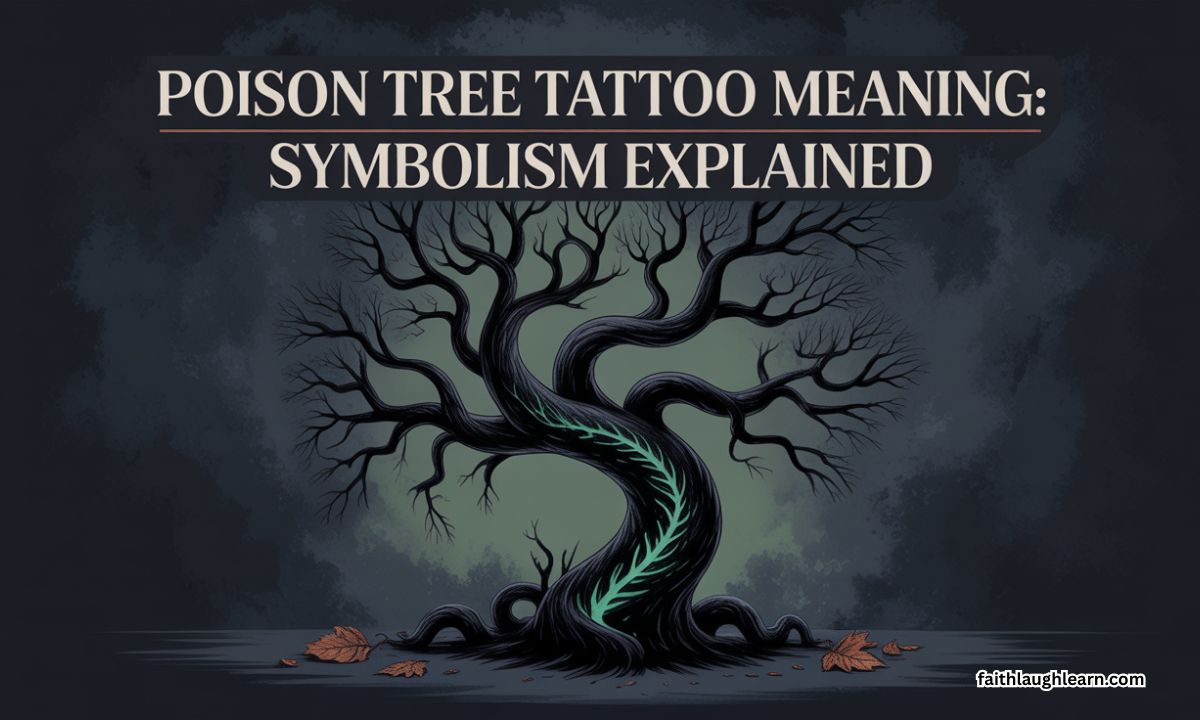
Poison tree tattoo meaning centers on one core idea: anger left unspoken doesn’t disappear; it grows into something toxic. Rooted in William Blake’s 1794 poem “A Poison Tree,” the design symbolizes suppressed resentment, betrayal, and the quiet damage of emotional dishonesty.
Behind every twisted branch lies a warning most people learn the hard way: the grudges we swallow don’t fade; they ferment, poisoning relationships from the inside long after the original wound heals.
This guide unpacks Blake’s literary roots, the psychology behind hidden anger, and how design choices, from blackwork to botanical realism, reshape the symbolism into something personal and lasting.
What Does a Poison Tree Tattoo Mean?
At its core, a poison tree tattoo represents suppressed anger, hidden resentment, and the emotional consequences of staying silent instead of confronting a problem. The tree grows from something poisonous — often anger that wasn’t expressed — and the fruit it produces represents the damage that unresolved emotion eventually causes.
Most people who choose this design are marking one of three things:
- A toxic relationship they’ve walked away from
- Personal transformation — turning pain into growth
- A literary connection to William Blake’s poem “A Poison Tree”
Unlike generic nature tattoos, this design carries a built-in narrative. It’s less about decoration and more about emotional honesty — an admission that anger, left unspoken, doesn’t disappear. It grows.
The Origins of the Poison Tree Symbol
William Blake’s “A Poison Tree” and Its Influence on the Design
The phrase and the imagery trace back directly to William Blake’s poem “A Poison Tree,” published in 1794 as part of his collection Songs of Experience. The poem’s opening lines set up the entire metaphor that tattoo enthusiasts have since adopted:
“I was angry with my friend; / I told my wrath, my wrath did end. / I was angry with my foe: / I told it not, my wrath did grow.”
This is the heart of the poison tree poem symbolism: anger expressed dissolves, but anger suppressed festers and grows into something dangerous. Blake continues the metaphor by describing how the narrator “watered” this hidden anger with fears, tears, and false smiles until it bore “an apple bright” — a poisoned fruit that ultimately kills the foe who eats it.
A William Blake symbolism analysis of the poem typically points to three layers of meaning: a psychological warning about repression, a moral commentary on deceit, and a subtle biblical echo of the Garden of Eden. That layering is exactly why the image translates so well into tattoo form — it’s visually simple but conceptually dense.
Poison Trees in Mythology and Folklore
Blake didn’t invent the poison tree as a symbol; he tapped into something older. Toxic or forbidden trees appear across multiple mythological traditions:
| Tradition | Symbol | Core Meaning |
|---|---|---|
| Judeo-Christian | Tree of Knowledge of Good and Evil | Temptation, forbidden knowledge, moral consequence |
| Norse mythology | Yggdrasil (in its darker interpretations) | Fate, decay intertwined with life |
| Greek mythology | The Hesperides’ guarded tree | Danger disguised as beauty |
| Southeast Asian folklore | The Upas tree | Literal and figurative poison spreading outward |
The Upas Tree Legend and Its Role in Tattoo Symbolism
The Upas tree deserves specific attention because it directly shaped 18th- and 19th-century European ideas about “poison trees,” including Blake’s own imagination. Erasmus Darwin and other writers of the era spread (heavily exaggerated) accounts of a Javanese tree so toxic it supposedly killed everything within miles of it. While the science was inaccurate, the legend cemented the poison tree as shorthand for something that spreads harm silently and expands its damage the longer it’s left alone — a theme that maps directly onto modern emotional repression symbolism.
Core Symbolic Meanings of a Poison Tree Tattoo
Suppressed Anger and Emotional Repression
This is the most direct and common interpretation. The tattoo acts as a permanent reminder of what happens when anger isn’t voiced. Hidden resentment psychology research — including work on emotional suppression by psychologists like James Gross — consistently shows that suppressing negative emotion doesn’t neutralize it; it tends to resurface later, often more intensely and in less controlled ways. Wearers often say the tattoo functions as a personal check-in: a visual cue to address feelings honestly instead of letting them “grow.”
Toxic Relationships and Emotional Betrayal
For many, the toxic relationship tattoo meaning is the primary reason they chose the design. The poisoned fruit represents betrayal, manipulation, or a friendship/relationship that looked appealing on the surface but caused real harm underneath. This connects to broader themes of broken trust, emotional manipulation, and passive aggression — the tattoo becomes a marker of surviving a dynamic where honesty was absent.
Growth From Pain — Turning Poison Into Strength
Not everyone wears this tattoo as a warning. Many choose it to mark personal transformation — proof that they processed something painful and came out the other side with more self-awareness. In this reading, the tree isn’t a threat; it’s evidence. It says: I recognized the poison in me, and I dealt with it instead of letting it define me.
Forgiveness vs. Holding a Grudge
Blake’s poem never resolves neatly — the narrator’s silence leads to their foe’s death, and there’s no clean redemption. That ambiguity is part of why the tattoo resonates: it doesn’t force a moral. Some wearers interpret it as a warning against holding grudges, choosing the design specifically as a reminder to practice forgiveness and emotional restraint. Others wear it as an honest acknowledgment of bitterness they haven’t fully released yet. Both interpretations are valid — the tattoo doesn’t demand resolution, only awareness.
Psychological Interpretation: Why the Symbol Resonates
The poem’s central line — “I was angry with my foe: I told it not, my wrath did grow” — captures a well-documented psychological pattern. When people avoid confrontation with someone they don’t trust (a “foe,” as opposed to a friend they feel safe being honest with), that unexpressed anger doesn’t dissolve. It compounds.
This is why the tattoo appeals strongly to people navigating:
- Recovery from unresolved trauma or betrayal
- Cognitive dissonance between how a relationship looks and how it feels
- Long-term inner conflict around unspoken resentment
- A desire for emotional healing after a period of silence or repression
Visual Style and Design Choices That Shape Meaning
The way a poison tree is rendered changes what it communicates. Style isn’t cosmetic here — it shifts the emotional register of the entire piece.
Blackwork and Linework Poison Trees
Bold blackwork versions lean into the dark tattoo meaning side of the symbol — starker, more gothic, emphasizing danger and warning over subtlety. This style suits wearers who want the toxic, cautionary side of the symbolism front and center.
Botanical/Realism Style
A botanical tattoo style rendering — detailed bark texture, realistic leaves, naturalistic fruit — softens the symbolism toward growth and transformation rather than menace. This works well for people who want the piece to read as “I grew through this” rather than “beware.”
Adding Symbolic Companions
Many wearers extend the poison tree tattoo symbolism by pairing it with additional imagery:
- Snakes — deceit, temptation, hidden danger (often reinforcing the Eden connection)
- Apples — the poisoned fruit itself; apple symbolism ties directly to Garden of Eden symbolism, forbidden fruit symbolism, and biblical symbolism around temptation and consequence
- Skulls — mortality, the literal “death” outcome in Blake’s poem
- Thorns — protection built from pain, or barriers formed after betrayal
- Exposed roots — instability, or resilience despite hidden damage
Color vs. Black-and-Gray — Does It Change the Meaning?
Black-and-gray remains the dominant choice for this design because it reinforces the gothic tattoo meaning and literary tattoo symbolism at the core of the piece. Color versions exist but are less common; when used, deep reds or sickly greens on the fruit are typically chosen deliberately to emphasize the “poison” itself rather than to make the piece decorative.
Placement and Size Considerations
Small and Minimalist Poison Tree Tattoos
A minimalist poison tree tattoo or small poison tree tattoo works well as a fine-line tattoo, often placed on the wrist, forearm, ribcage, or behind the ear. Minimalist versions typically simplify the tree to a single line-art silhouette with one or two pieces of fruit, keeping the design personal and low-key rather than a visual statement piece.
Large-Scale and Full-Sleeve Concepts
Larger interpretations — half-sleeves, back pieces, or thigh pieces — allow room for the full narrative: roots, trunk, branches, fruit, and companion symbols like snakes or a small Eden-inspired background. These pieces tend to be chosen by people who want the tattoo to read as a complete story rather than a single symbol.
Best Placements for Visibility vs. Privacy
| Placement | Visibility | Common Reason for Choice |
|---|---|---|
| Wrist/forearm | High | Personal reminder seen daily |
| Ribcage / hip | Low | Private, deeply personal meaning |
| Behind the ear | Low | Subtle, minimalist statement |
| Upper arm/sleeve | Medium–High | Statement piece, detailed storytelling |
| Back / thigh | Low (easily covered) | Room for large, detailed compositions |
Who Gets a Poison Tree Tattoo — and Why
People choose this meaningful tattoo design for distinct, specific reasons rather than aesthetic appeal alone:
- Recovering from a toxic relationship or friendship — marking the end of a dynamic built on broken trust or infidelity symbolism
- Literary connection — genuine fans of William Blake and Romantic-era poetry who want a literary tattoo meaning tied to a specific text
- Personal growth markers — a permanent note-to-self about emotional boundaries and communication and honesty going forward
- Memorial or reflective pieces — for processing grief connected to a relationship that ended badly, rather than through peaceful resolution
Case in point: In online tattoo communities (Reddit’s r/tattoos and similar forums), a recurring theme among people sharing their poison tree pieces is timing — the tattoo is frequently gotten within months of leaving a relationship or job situation defined by dishonesty, functioning as a closing chapter marker rather than an impulsive design choice.
Poison Tree Tattoo Meaning for Men vs. Women
The underlying poison tree tattoo meaning doesn’t shift by gender — suppressed anger, betrayal, and transformation are universal themes. What tends to differ is style preference: fine-line, smaller-scale versions are more commonly requested by women, while bolder blackwork and larger compositions are more common among men. Neither pattern is a rule, and increasingly, style choice is driven more by personal taste and placement than by gender norms.
Things to Discuss With Your Tattoo Artist
Questions to Ask Before the Session
- Can you show me references that balance the botanical tattoo style with symbolic elements like fruit or roots?
- How will this design age — will fine linework hold up long-term at this size?
- Can we incorporate a companion symbol (snake, apple, thorns) without overcrowding the composition?
- What placement do you recommend for the level of detail I want?
How Pain and Healing Vary by Placement
Ribs, spine, and inner arm placements tend to rank higher on pain scales due to thinner skin and proximity to bone, while outer forearms and calves are generally more tolerable. Healing typically takes two to three weeks for surface healing, with full settling of ink and skin texture taking up to six months, regardless of placement — though larger, more detailed pieces (common with full poison tree scenes) may need touch-ups after the initial healing window to sharpen fine linework.
Common Mistakes to Avoid
- Choosing size without considering detail — overly intricate branch and root work shrunk to a small size often blurs within a few years
- Skipping the symbolism conversation with your artist — a skilled tattoo artist familiar with literary tattoo symbolism can help balance meaning with visual clarity
- Ignoring placement and lifestyle — visible placements carry different professional and social considerations than concealed ones
- Rushing the decision — because this design is tied to emotional processing, getting it too soon after a painful event can sometimes conflict with how the meaning feels years later
Best Practices for a Meaningful Result
- Research your artist’s portfolio specifically for botanical or gothic linework, not just general tattooing skill
- Decide whether the piece should communicate warning (blackwork, stark) or growth (botanical, softer) before finalizing sketches
- Consider whether companion symbols (snake, apple, thorns) add clarity or unnecessary clutter
- Give yourself time between the triggering event and the appointment — this ensures the symbolic meaning still feels accurate years down the line
Conclusion
Understanding poison tree tattoo meaning comes down to one simple truth. Anger that stays hidden doesn’t vanish. It grows, spreads, and eventually causes harm. This tattoo captures that lesson in a single image: a tree, its fruit, and the quiet danger of silence over honesty.
Whatever style or size you choose, the poison tree tattoo meaning stays personal to you. It can mark a toxic relationship you left behind, or growth you’re proud of. Either way, it’s a reminder to speak your truth before it turns into something you carry alone.
FAQs
What is the poison tree tattoo meaning in simple terms?
It represents suppressed anger that grows into something harmful when left unspoken, based on William Blake’s poem “A Poison Tree.”
Is a poison tree tattoo only about anger?
No, many people choose it to represent personal growth, healing, or moving on from a toxic relationship.
Where is the best placement for a poison tree tattoo?
Forearms and wrists work well for visible, daily reminders, while ribs or thighs suit those who prefer a private, personal meaning.
Does the poison tree tattoo meaning connect to religion?
It can, since the imagery echoes the Garden of Eden and biblical themes of temptation and consequence, though this reading isn’t universal.
How much does a poison tree tattoo typically cost?
Pricing varies widely by artist, detail, and size, so it’s best to request a direct quote from a tattoo studio you trust.

Hi, I’m Lucas Harper, a content writer at FaithLaughLearn. I enjoy creating meaningful and engaging content that inspires, entertains, and helps readers learn something new every day.
From exploring symbols and meanings to sharing uplifting ideas and fun puns, I love writing content that is simple, relatable, and enjoyable for everyone. My goal is to make learning feel interesting while bringing positivity and creativity to every article I write.
From exploring symbols and meanings to sharing uplifting ideas and fun puns, I love writing content that is simple, relatable, and enjoyable for everyone. My goal is to make learning feel interesting while bringing positivity and creativity to every article I write.