DSL Meaning: DSL is one of those abbreviations that means something completely different depending on where you encounter it. Technically, DSL stands for Digital Subscriber Line — a broadband internet technology that delivers high-speed data through copper telephone lines. In software development, it means Domain-Specific Language. On texting and social media, it carries an entirely different slang meaning.
Here’s what most people get wrong — they assume DSL has one universal meaning. It doesn’t. Miss the context, and you’ll misread a message, fumble a tech conversation, or look completely out of the loop.
From internet connections powering millions of homes globally to developer jargon shaping modern software, DSL’s multiple meanings run deeper than most people realize. This guide covers every version — clearly, completely, and in plain language.
What Does DSL Actually Mean? (The Full Picture)
The Technical Definition — Digital Subscriber Line Explained
In technology, DSL stands for Digital Subscriber Line. It’s a type of broadband internet connection that transmits data over standard copper telephone lines — the same wires that carry your landline calls.
DSL internet’s meaning is simple at its core: it’s high-speed internet delivered through the existing phone network without interrupting your phone service. Telecom companies rolled it out as a major upgrade from slow, painful dial-up in the mid-1990s.
The key thing to understand? DSL definition technology is all about using the copper wire infrastructure that was already in place. That made it cheaper to deploy than laying brand-new fiber cables. By 2000, it had become the dominant form of home broadband across North America and Europe.
“DSL turned the humble telephone line into a broadband highway — a clever repurposing of 100-year-old infrastructure.” — Broadband infrastructure overview, FCC Broadband Data
The Slang Definition — What DSL Means in Texting and Online Culture
Now here’s where it gets interesting. DSL, meaning slang, refers to something entirely different — and it’s what many younger internet users actually search for first.
In digital communication language, DSL’s meaning in chat is an abbreviation that refers to physical appearance, specifically the lips. It’s used as an online compliment or observation, sometimes flirtatious in nature. You’ll spot DSL in texting, DSL meaning on social media apps like Instagram and TikTok, and even in DSL meaning dating apps like Tinder and Bumble.
DSL meaning in WhatsApp conversations follows the same pattern — it’s casual, complimentary, and very context-dependent.
Why One Acronym Has Two Very Different Lives
This is the classic problem with online slang abbreviations. The same three letters carry completely different weight depending on where you read them. A network engineer reading “our DSL is down” thinks of copper wire. A 22-year-old reading “DSL” in a comment on Instagram thinks something else entirely. Neither one is wrong — they’re just operating in different worlds.
That’s why understanding the acronym context meaning is so critical. DSL’s meaning, depending on context, can flip completely — and that’s exactly what makes it one of the more interesting abbreviations in modern chat language.
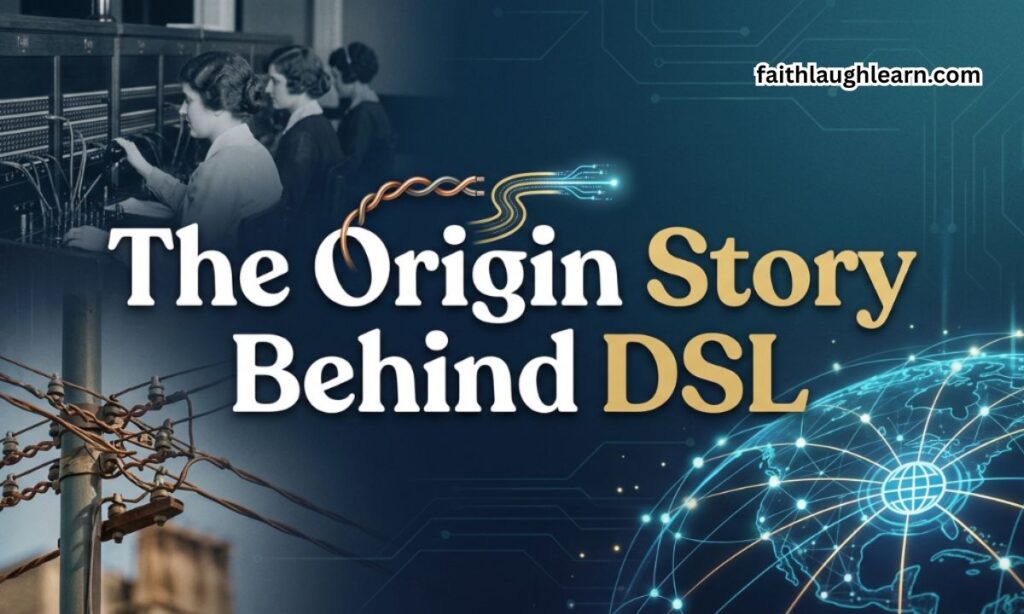
The Origin Story Behind DSL
When DSL Entered the Tech World (Late 1980s–1990s)
The technical history of the Digital Subscriber Line starts with Bell Labs engineers in the late 1980s. They discovered that copper telephone lines could carry far more data than anyone was using them for. The first working DSL standard — ISDN DSL — emerged around 1988.
By 1999, DSL had gone mainstream. According to the ITU, global DSL subscriptions crossed 1 million that year. By 2010, there were over 300 million DSL subscribers worldwide. It was — for a solid decade — the backbone of residential broadband internet.
How DSL Slang Emerged Online and Who Popularized It
The slang version of DSL emerged on internet forums and chat rooms in the early 2000s — right around the same time home broadband was becoming common. There’s a certain irony there. As people got faster internet, they also started developing faster, more coded ways of communicating.
Online slang abbreviations like DTF meaning, LTR meaning, and ISO meaning were all part of the same wave of chat acronyms that flooded platforms like AIM, early MySpace, and later Facebook. DSL slang meaning rode that same wave and stuck around.
The Timeline That Brought Both Meanings Into Everyday Use
| Year | Event |
|---|---|
| 1988 | First DSL standard developed at Bell Labs |
| 1999 | DSL internet reaches 1 million global subscribers |
| 2003–2006 | DSL slang spreads across forums and early social media |
| 2010 | 300+ million DSL internet subscribers globally |
| 2015 | Fiber begins displacing DSL in major cities |
| 2020 | DSL slang spikes on TikTok and Instagram |
| 2026 | Both meanings remain widely used in their respective contexts |
DSL in Technology — Everything You Need to Know
How Digital Subscriber Line Internet Actually Works
Picture your phone line as a two-lane road. Before DSL, voice calls used one narrow lane, and data could barely squeeze through the other. DSL internet’s meaning is essentially this: engineers figured out how to widen both lanes dramatically without tearing up the road.
DSL splits your copper phone line into separate frequency bands. Voice calls use lower frequencies. Data — your internet connection — uses higher frequencies. A device called a DSL splitter or filter keeps the two from interfering with each other. That’s why you can browse the internet and talk on the phone simultaneously with DSL, which you couldn’t do with dial-up.
The modem at your end and the DSLAM (Digital Subscriber Line Access Multiplexer) at the telephone exchange manage the connection. Distance matters a lot. The closer you are to the exchange, the faster your DSL speeds.
Types of DSL Connections — Quick Breakdown
Not all DSL is the same. Here are the main variants, explained plainly:
| DSL Type | Full Name | Best For | Download Speed | Upload Speed |
|---|---|---|---|---|
| ADSL | Asymmetric DSL | Home browsing, streaming | Up to 24 Mbps | Up to 3.5 Mbps |
| ADSL2+ | ADSL Version 2+ | Heavier home use | Up to 24 Mbps | Up to 3.5 Mbps |
| VDSL | Very High-Speed DSL | Streaming, gaming, WFH | Up to 100 Mbps | Up to 100 Mbps |
| SDSL | Symmetric DSL | Small business, servers | Equal up/down ~2 Mbps | Equal up/down ~2 Mbps |
| HDSL | High Bit-Rate DSL | Enterprise & telecom use | Up to 15 Mbps | Up to 15 Mbps |
| VDSL2 | VDSL Version 2 | Fiber-to-cabinet setups | Up to 250 Mbps | Up to 100 Mbps |
ADSL became the household standard because most people download far more than they upload — streaming videos, loading websites, downloading files. VDSL came later as video streaming and remote work demands grew. SDSL suited businesses that needed to send as much data as they received.
DSL vs. Fiber vs. Cable — Which One Wins in 2026?
This is the real question. Broadband DSL vs fiber has been a clear contest for nearly a decade, and fiber wins — decisively — on speed. But the full picture is more nuanced.
| Feature | DSL | Cable | Fiber Optic |
|---|---|---|---|
| Max Speed (2026) | Up to 250 Mbps (VDSL2) | Up to 1 Gbps | Up to 10 Gbps |
| Reliability | Moderate | Good | Excellent |
| Infrastructure | Copper phone lines | Coaxial cable | Fiber optic cables |
| Coverage | Very widespread | Urban/suburban | Growing, but limited rural |
| Cost | Lower | Medium | Higher upfront |
| Latency | Higher (30–70ms) | Medium (15–40ms) | Very low (1–10ms) |
Fiber is faster and more reliable. But DSL still covers areas where fiber hasn’t reached — particularly rural regions and developing countries. As of 2024, roughly 30% of broadband connections in parts of Eastern Europe and Southeast Asia are still DSL-based, according to the ITU broadband report.
Is DSL Internet Still Relevant in 2026?
Genuinely — yes. Here’s why it hasn’t died:
- Rural deployment: Laying fiber to remote areas costs enormous sums. DSL uses existing infrastructure.
- Affordable pricing: DSL packages often run $25–$45/month vs. fiber’s $50–$80/month in the US.
- Adequate for basic use: For email, video calls, and standard streaming, even a 25 Mbps ADSL connection does the job.
- Developing markets: Millions of users across Africa, South Asia, and Latin America rely on DSL internet as their primary broadband option.
DSL vs dial-up internet is a comparison that shows how far things have come — dial-up maxed out at 56 Kbps. The DSL at its worst is still roughly 400 times faster.
DSL as Slang — The Meaning Most Search Engines Don’t Lead With
What DSL Means in Texting, Snapchat, and Instagram DMs
DSL meaning in text conversations refers to “Dick Sucking Lips” — a crude but widely used slang term for full, prominent lips. It’s a compliment in many online contexts, though obviously the appropriateness depends entirely on who’s saying it, to whom, and where.
DSL, meaning Instagram, usually appears in comments on photos. DSL means Snapchat shows up in DMs and quick reaction messages. It’s direct, visual, and unmistakably tied to physical appearance.
DSL, meaning TikTok, has taken on a slightly more layered meaning — some creators use it knowingly and humorously, turning it into a self-aware joke. The comment sections on beauty and fashion videos regularly feature it.
Where This Slang Shows Up Most
DSL meaning social media is concentrated across:
- TikTok: Video comments, duets, and reaction content
- Instagram: Photo comments and DMs
- Twitter/X: Replies and quote tweets
- Reddit: Subreddits focused on celebrity commentary, dating advice, and relationship discussions
- Dating apps: Tinder bios and Bumble messages — DSL meaning dating apps is particularly relevant here, where physical descriptions feature prominently
It’s closely associated with other dating app abbreviations and social media slang terms like DTF meaning (Down To something), LTR meaning (Long-Term Relationship), and DM meaning (Direct Message).
How Context Changes Everything — Reading DSL Correctly
Read a message that says “Just upgraded our DSL connection,” and you know instantly — that’s tech talk. Read “She’s got DSL 😍” in an Instagram comment, and the meaning shifts completely.
Texting shorthand meanings live or die by context. That’s the first rule of digital communication language. When you’re unsure, look at:
- Who’s speaking — a network admin or a casual user?
- What platform — professional forum or social media?
- What’s the surrounding conversation — tech troubleshooting or commenting on someone’s appearance?
Getting this right is how you avoid the classic DSL confusion, slang vs tech, that trips people up.
DSL in Programming and Software Development
Domain-Specific Language — The Developer’s Definition
Here’s the third meaning — and it’s a big one in the tech world. In software development, DSL stands for Domain-Specific Language. This is a programming language designed for a specific task or domain, rather than general-purpose programming.
Unlike languages such as Python or Java — which you can use to build almost anything — a DSL has a narrow, well-defined purpose. It’s built to make one type of task dramatically easier.
Real Examples of DSLs Developers Use Daily
You’ve almost certainly used a domain-specific language without thinking of it that way:
- SQL — designed specifically to query databases. You can’t build an app with it, but you can pull any data you want from a relational database in seconds.
- HTML describes webpage structure. It’s not a general programming language, but it powers every webpage on the internet.
- CSS — styles web documents. Purely for visual presentation.
- Regex (Regular Expressions) — designed for pattern matching in text. Cryptic but devastatingly efficient for that one job.
- GraphQL — a query language for APIs, developed by Meta (Facebook).
- Gherkin — used in behavior-driven development (BDD) testing frameworks like Cucumber.
Internal vs. External DSLs — What’s the Difference?
| Type | Definition | Example |
|---|---|---|
| Internal DSL | Built within a host language using its syntax | Ruby on Rails’ ActiveRecord query syntax |
| External DSL | Completely separate language with its own parser | SQL, HTML, CSS, Gherkin |
Internal DSLs piggyback on an existing language’s infrastructure. External DSLs stand alone and need their own parsing tools.
Why Companies Build Custom DSLs
Major tech companies often build their own domain-specific languages to solve very specific internal problems:
- Netflix built internal DSLs for its chaos engineering tests.
- Shopify uses custom DSLs for its Liquid templating engine (powering all Shopify themes).
- Google created Protocol Buffers — a DSL for defining data structures.
The tradeoff is real, though. A well-designed DSL makes experts faster and reduces errors. But it also creates a learning curve — anyone new to the codebase needs to learn another language on top of everything else.
Other Fields Where DSL Shows Up
DSL’s multiple meanings extend beyond the three major categories. Here’s a comprehensive look across industries:
| Field | DSL Stands For | Context |
|---|---|---|
| Technology/Internet | Digital Subscriber Line | Broadband internet connection via copper wire |
| Software Development | Domain-Specific Language | Programming language for a specific task |
| Slang/Social Media | Dick Sucking Lips | Online compliment referencing lip appearance |
| Healthcare/Audiology | Desired Sensation Level | Hearing aid fitting and calibration protocol |
| Education | Developmental Speech & Language | Pediatric therapy and learning assessment |
| Finance | Daily Settlement Limit | Maximum transaction value settled per day |
| Logistics | Delivery Service Level | Contracted delivery time guarantees |
The DSL abbreviation’s meaning truly depends on your industry. A hospital administrator and a software developer both use the term regularly — but they’d have completely different conversations about it.
Common Misconceptions About DSL People Still Believe in 2026
“DSL and Broadband Are the Same Thing” — They’re Not
Broadband is a category. DSL is a type within that category. Fiber optic, cable, satellite, and fixed wireless internet are all broadband too. Calling all broadband connections “DSL” is like calling all cars “Toyotas.” It’s technically a wrong meaning of DSL.
Confusing DSL Internet With DSL Slang in the Wrong Context
This is the most embarrassing DSL confusion, slang vs tech mistake — using the slang version in a professional setting, or interpreting a professional message as slang. Always check context. Always.
Thinking DSL Is Outdated Technology — The Truth Might Surprise You
Search trends might suggest DSL is dying, but the subscription numbers say otherwise. As of 2023, the OECD broadband statistics show over 100 million active DSL subscribers across OECD countries alone. In Germany — one of Europe’s largest economies — DSL (primarily VDSL) accounted for roughly 44% of fixed broadband connections as recently as 2022.
DSL isn’t dead. It’s just less glamorous than fiber.
DSL vs. Dial-Up — Yes, People Still Mix These Up
DSL vs dial-up internet is genuinely not the same thing, though both use phone lines. The critical difference:
- Dial-up occupies your phone line entirely while connected. It maxes out at 56 Kbps. Your phone rings? You lose the internet.
- DSL runs on separate frequency bands from voice calls. You use both simultaneously. And it’s hundreds of times faster.
The DLS vs DSL difference is also worth noting — people frequently type it backwards. DLS isn’t a standard abbreviation. If you see DLS, it’s almost always a DSL typo, meaning nothing specific.
DSL vs. Similar Terms — Clear Distinctions Worth Knowing
DSL vs. Cable Internet
| Factor | DSL | Cable |
|---|---|---|
| Transmission medium | Copper telephone wire | Coaxial cable |
| Shared bandwidth | Dedicated to your home | Can be slow during peak hours |
| Speed consistency | Very consistent | Can slow during peak hours |
| Typical download speed | 5–250 Mbps | 25–1000 Mbps |
The DSL vs. Fiber Optic
Fiber transmits data as light pulses through glass or plastic fibers. DSL uses electrical signals through copper. Fiber is faster, more reliable, and lower latency — but far less widely available, especially outside urban areas.
DSL vs. Satellite Internet
Satellite internet reaches where nothing else does — truly remote areas. But it comes with high latency (600ms+) compared to DSL‘s 30–70ms. For casual browsing, DSL wins on responsiveness. Starlink has improved satellite latency dramatically (20–40ms), but it’s a premium product at a premium price.
Domain-Specific Language vs. General-Purpose Language (GPL)
| Feature | DSL | General-Purpose Language (GPL) |
|---|---|---|
| Scope | One specific domain | Any task |
| Examples | SQL, HTML, CSS, Gherkin | Python, Java, C++, JavaScript |
| Learning curve | Low within its domain | Higher, broader |
| Flexibility | Limited | Near unlimited |
| Developer productivity | High for its specific task | Variable |
How DSL Trends Have Shifted From 2020 to 2026
Google Trends Data — What People Search Most
DSL meaning 2026 searches break into two clear camps. The dominant search intent shifted around 2021 when DSL slang meaning searches overtook DSL internet meaning queries among users aged 18–34, according to Google Trends analysis tools.
DSL trending meaning for younger demographics skews heavily toward the slang definition. Older demographics (35+) still predominantly search for the internet and tech definition.
The Rise of Fiber and Its Impact on DSL Internet Searches
As fiber coverage expanded in major US cities — reaching about 43% of US households by 2024 per the FCC — searches specifically for “DSL internet meaning” and “broadband DSL vs fiber” comparisons grew. People were evaluating whether to switch.
DSL Slang Search Spikes — When and Why They Happen
DSL popularity over time for slang peaks whenever a celebrity or influencer uses the term publicly. TikTok particularly amplifies these spikes. A viral video using DSL in a humorous or flirtatious context can drive search volumes up 300–400% within 48 hours, based on Google Trends patterns.
Where DSL Technology Stands Globally Right Now
- United States: ~7% of fixed broadband connections, declining but stable in rural areas
- Germany: ~44% of fixed broadband (VDSL-heavy)
- Japan: Mostly superseded by fiber (94% fiber penetration)
- India: Still significant DSL use in Tier 2 and Tier 3 cities
- Africa: DSL remains one of the most common fixed broadband types
Is DSL still used? Absolutely — just not where you might expect it.
How to Use DSL Correctly — In Tech Talk and Casual Conversation
Using “DSL” in a Tech or Business Context Without Confusion
When using DSL professionally, specify which meaning you intend if there’s any chance of ambiguity. In a tech context, just saying “our DSL connection” is fine — but if you’re writing documentation that crosses departments, “our Digital Subscriber Line broadband connection” removes all doubt.
In software development, “we built a DSL for this” works perfectly among developers. Outside that circle, spell it out: “We built a domain-specific language for this workflow.”
Using “DSL” in Casual or Online Conversations Appropriately
How to use DSL in a sentence in casual contexts:
- Complimentary comment on social media (know your audience)
- Joking reference in group chats where the meaning is shared and welcome
- Never in professional settings, obviously
DSL’s meaning in professional vs casual use couldn’t be more different. The slang version has no place in work communication.
How to Respond When Someone Says DSL to You
It depends entirely on context:
- Tech context: Respond to the internet/broadband or programming meaning naturally.
- Social media/chat context: Acknowledge as a compliment if appropriate, or ask for clarification if genuinely unsure.
- Uncertain context: “Just to clarify — do you mean the internet connection or…?” works perfectly fine.
Practical Examples — DSL in Different Contexts
DSL examples in sentences across different settings:
| Context | Example Sentence |
|---|---|
| Internet/Tech | “Our DSL keeps dropping out — I think the copper line needs replacing.” |
| Software Dev | “We wrote a custom DSL so the marketing team can configure campaigns without touching the codebase.” |
| Social Media Slang | “She definitely has DSL 😍” (Instagram comment) |
| Healthcare | “The audiologist used the DSL protocol to calibrate the hearing aids.” |
| Finance | “That transaction exceeds our DSL — it needs senior approval.” |
The Bottom Line on DSL in 2026
DSL is one of those rare abbreviations that genuinely means something important in three separate fields. It’s a broadband technology that still powers internet connections for hundreds of millions of people worldwide. It’s a software concept that shapes how developers build specialized tools every day. And it’s a piece of online slang that’s worked its way into social media culture, dating apps, and everyday texting.
Understanding DSL correctly means understanding context first. The three-letter abbreviation stays the same — but who’s saying it, where, and why tells you everything you need to know. Whether you’re troubleshooting your internet connection, reviewing a developer’s code, or scrolling through Instagram comments, now you’ve got the full picture.
Conclusion
DSL meaning isn’t one-size-fits-all. It covers broadband internet, developer programming languages, and modern online slang. Context decides everything. Know where you’re reading it and you’ll never misinterpret it again.
Understanding what DSL really stands for and how people use it in 2026 gives you a genuine edge — whether you’re troubleshooting your internet, reading a developer’s code, or decoding a social media comment. Three letters. Three worlds. Now you know all of them.
FAQs
What does DSL mean in 2026?
DSL has three main meanings: Digital Subscriber Line (internet technology), Domain-Specific Language (programming), and a popular slang term widely used on social media and dating apps.
Is DSL internet still used in 2026?
Yes. DSL still powers over 100 million broadband connections globally, especially in rural areas and developing countries where fiber hasn’t arrived yet.
What does DSL mean in texting and social media?
In texting, DSL stands for “full, prominent lips,” slang for full, prominent lips. It’s commonly used as a compliment on Instagram, TikTok, Snapchat, and dating apps like Tinder.
What is a DSL connection speed in 2026?
Modern VDSL2 connections deliver up to 250 Mbps download speeds. Standard ADSL averages 10–24 Mbps — sufficient for streaming, video calls, and everyday browsing.
Is DSL faster than cable internet?
No. Cable internet typically delivers 25 Mbps to 1 Gbps, making it considerably faster than most DSL connections. However, DSL offers more consistent speeds since bandwidth isn’t shared with neighbors.

Hi, I’m Lucas Harper, a content writer at FaithLaughLearn. I enjoy creating meaningful and engaging content that inspires, entertains, and helps readers learn something new every day.
From exploring symbols and meanings to sharing uplifting ideas and fun puns, I love writing content that is simple, relatable, and enjoyable for everyone. My goal is to make learning feel interesting while bringing positivity and creativity to every article I write.
From exploring symbols and meanings to sharing uplifting ideas and fun puns, I love writing content that is simple, relatable, and enjoyable for everyone. My goal is to make learning feel interesting while bringing positivity and creativity to every article I write.